Regulatory and safety
LNG storage is regulated. We run the process while the equipment is being built.
NFPA 59A siting, recertified vessels, and an AHJ package prepared in parallel with refurbishment.
The codes
- NFPA 59A, the standard for LNG production, storage, and handling, adopted through state and local fire codes.
- 49 CFR Part 193 and PHMSA for facilities under federal jurisdiction.
- ASME Section VIII and the National Board R-stamp for any repair to pressure-retaining parts.
- Local fire code, zoning, and environmental review as applied by the authority having jurisdiction.
Siting
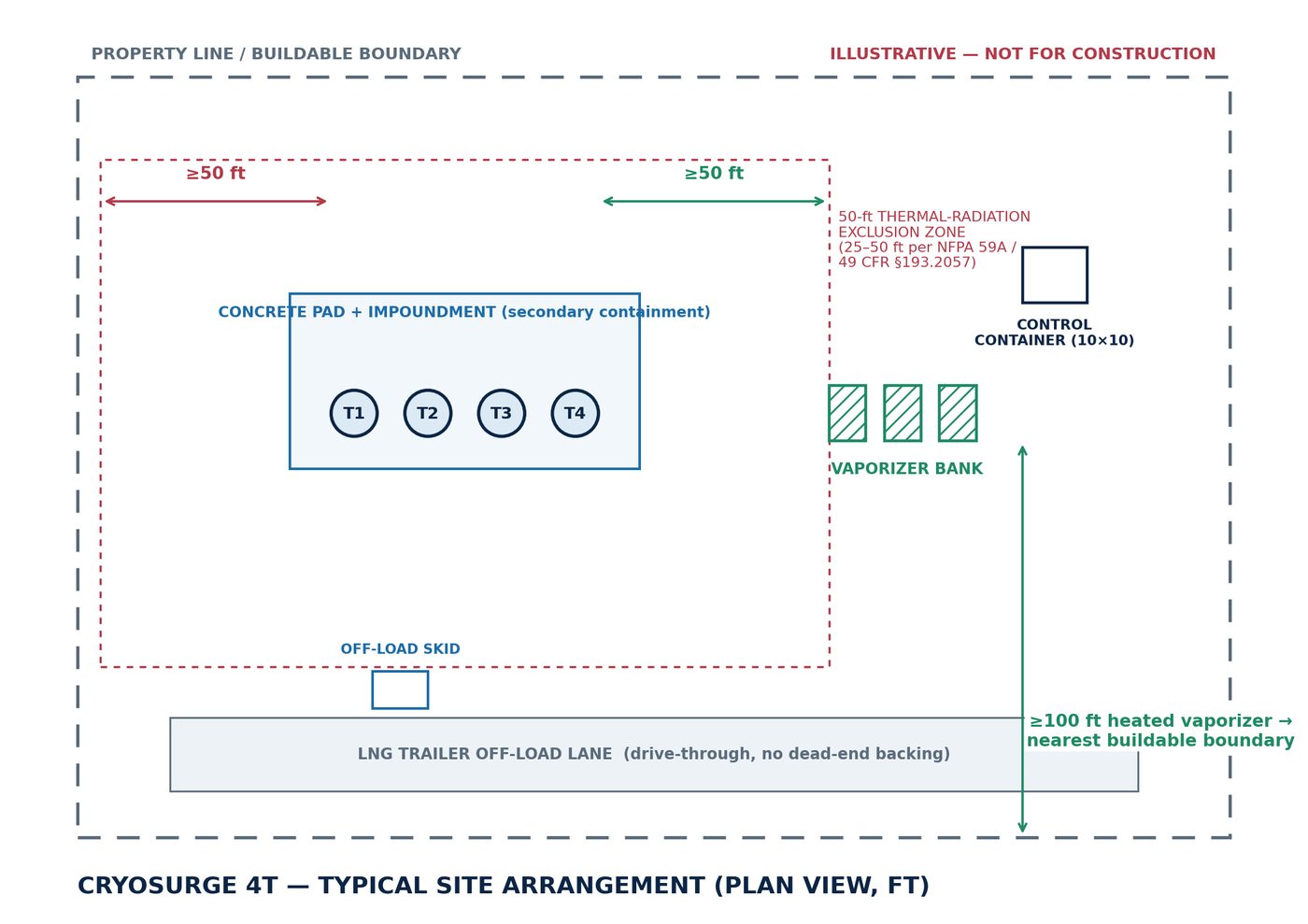
- Thermal-exclusion setbacks of about 25–50 ft from tanks to property lines and structures.
- Heated vaporizers at least 100 ft from a buildable property line and 50 ft from the LNG container.
- Secondary containment: double-wall vessels or impoundment sized to the largest tank.
- Vapor-dispersion and thermal-radiation analysis per NFPA 59A for the specific site.
Equipment integrity
- Every vessel inspected and recertified before deployment; vacuum readings documented.
- R-stamp on any pressure-vessel repair.
- Relief valves inspected and set-point tested every 2 years (maximum 30 months).
- GuardLogix safety PLC, ESD, gas and flame detection, interlocks in the control container.
The AHJ process
1
Pre-application
Site arrangement, setbacks, and containment concept presented to the AHJ before filing.
2
Submittal
NFPA 59A compliance package, P&IDs, electrical and controls drawings, emergency plan outline.
3
Review and approval
Comment responses, inspections at installation and commissioning. Typically 6–18 months in total.
Permitting runs in parallel with the 60–120 day refurbishment and shipping window. The equipment is never the critical path; the AHJ is, and we work it from day one.
Why gas permits where diesel cannot
| LNG with CryoSurge | Diesel generators | |
|---|---|---|
| Non-emergency run limit | Per air permit; can run as primary supply | EPA: 50 hours a year; CA SB 887/978, WA (25 hr at Sabey), NY moratorium |
| Fuel shelf life | Does not degrade; active boil-off management in standby | 6–12 months; fuel polishing required |
| Emissions | 40–70% lower; easier NOx and PM2.5 permitting | NOx and PM2.5 limits increasingly binding |
| Bridge power for years | Yes, then backup | Not legally |
Illustrative site arrangements for CryoSurge 3T and 4T are available on the module pages and as a downloadable template on the resources page. Not for construction.