Resources
Downloads, answers, and what we are learning.
Everything a project team needs before the screening call.
Downloads
CryoSurge one-pager
The gap, the solution, the modules, on one page for a first meeting.
Download PDF [USER: export from deliverables]Site arrangement template
Illustrative NFPA 59A layouts for CryoSurge 3T and 4T with setbacks and containment. Not for construction.
Download PDF [USER: export]Commercial sales offering
Full offering: modules, specifications, pricing, deployment scenarios, equipment provenance.
Request by emailInsights
Articles publish on the schedule in the campaign playbook. Planned titles:
- Bridge power for data centers without pipeline gas: what actually works in 2026
- LNG vs diesel backup under the EPA 50-hour rule
- How many LNG trailers does a 50 MW plant need?
- NFPA 59A setbacks explained for data center site planners
- Refurbished cryogenic tanks: what recertification and the R-stamp mean
- Why fuel haulers should lease storage, not just deliver gas
Frequently asked questions
What exactly arrives on site?
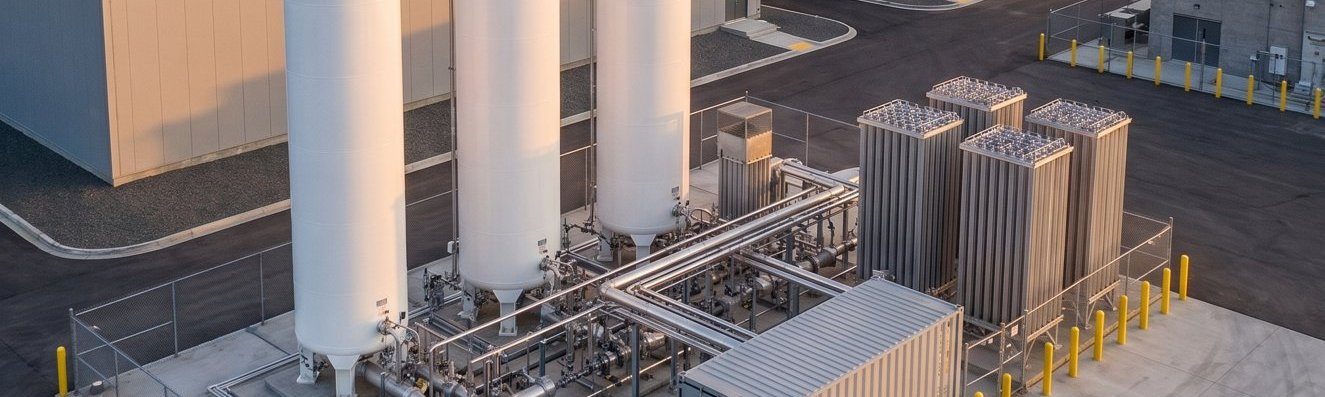
Three or four 18,000-gallon vertical LNG tanks, an ACD TC-34 dual pump skid plus a single load pump, two CryoQuip ambient vaporizers, a 10×10 control container with Allen-Bradley CompactLogix and GuardLogix PLCs, and the cryogenic piping and electrical between them.
How fast can it ship?
Equipment ships in 60–120 days from a signed contract and deposit. Permitting runs in parallel and typically takes 6–18 months.
Why refurbished equipment?
New tanks take 12–18 months and cost $250,000–350,000 each under the 2025 tariff stack. Our fleet is already in the country, with known service history, and every module is recertified before deployment.
Who made the equipment?
Chart, CVA, and Taylor-Wharton tanks; ACD pumps; CryoQuip and Nikkiso vaporizers; Allen-Bradley controls.
What permits do I need?
Local AHJ approval under NFPA 59A, and 49 CFR §193 where applicable. We prepare the layout, setbacks, containment, and the submittal package.
How much land does a module need?
Setbacks run 25–50 ft from tanks to property lines and structures; heated vaporizers sit at least 100 ft from a buildable property line and 50 ft from the tanks. We provide a site arrangement drawing at screening.
Can it run as primary supply, not just backup?
Yes. That is the core case: primary gas until the pipeline arrives, backup afterward.
How many trailers will I need?
About 12–13 a day at 50 MW, 25 or more at 100 MW. The module is the buffer that lets deliveries run on a schedule instead of a panic.
Does LNG go bad?
No. Diesel degrades in 6–12 months and needs polishing; LNG does not degrade. Standby modules carry boil-off management to hold fuel without venting.
Why not diesel?
EPA caps non-emergency diesel generator use at 50 hours a year; California, Washington, and New York restrict it further. LNG can run as long as the permit allows and cuts emissions 40–70%.
Do you provide the generators?
No. LNGVault stores and delivers fuel. Under the Power-as-a-Service bundle we coordinate a named generation partner.
Lease or buy?
Buy if you capitalize infrastructure; lease at an indicative $4,000–5,000 per tank per month if you want opex and a maintained asset. Every proposal quotes both.
What happens at the end of a lease?
Buy out at residual, extend, or return the module for redeployment.
Who maintains it?
LNGVault with Markey Cryo and GE4S: inspections, relief-valve testing every 2 years, pump and vaporizer service, PLC support, 24/7 line.
Can I start small and grow?
Yes. Pods scale from one module to a hyperscale farm with N+1 piping; multi-module pricing is linear.
Where do you operate?
Wave 1: Texas, Ohio, Georgia. Wave 2: Virginia, Arizona. Other states by project.